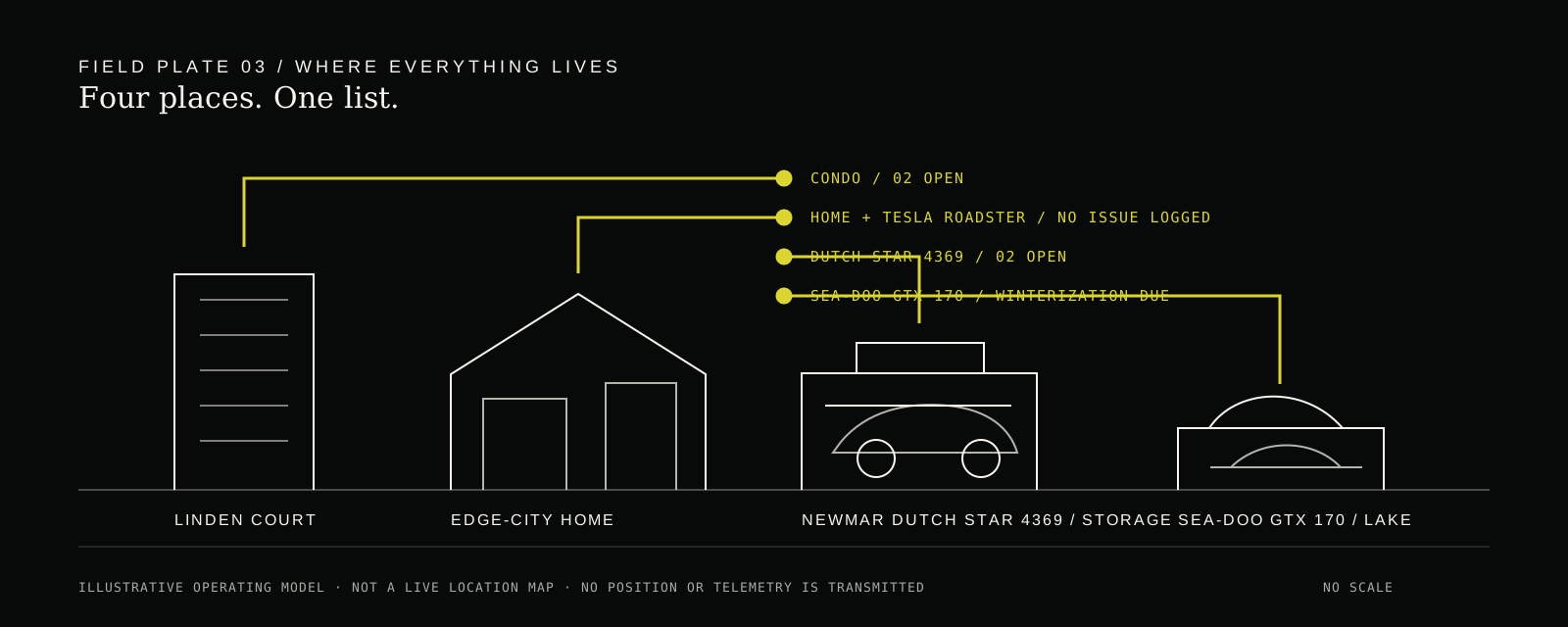
At 8:12 on a Saturday morning, four unrelated things come back to mind. The bathroom fan at Linden Court still rattles. The Dutch Star’s AC stopped keeping up on the last trip. There is a Roadster service note to look up and a Sea-Doo winterization appointment to keep track of. You meant to deal with each of them. Together they can eat the morning.
The problem is not a lack of screens. There are already too many. The building has a portal. The car’s service notes are somewhere else. Manuals, checklists, and reminders are scattered through the rest. Each holds a piece. You are still expected to remember the whole.

Ownership is a queue of small promises made to the future.
01 / Fragment
Four things, four versions of what is going on
A resident reporting a problem may need to attach photos, give permission to enter, and suggest a time for the visit. AppFolio’s official resident-portal guide describes that process, along with messages and request status.05 It is built around a resident and a property manager.
Connected vehicles organize their information differently. Tesla’s official Fleet API uses permission scopes to separate vehicle data, location, commands, charging, and service information.07 Booking service is a separate process, with estimates, messages, approvals, and visit history.08
Some RV systems provide selected coach controls and status information. Winnebago’s Connect documentation also spells out limits around models, connectivity, compatibility, and accounts.06 Sea-Doo offers connected navigation, while maintenance guidance for each model still lives in separate owner documentation.0910
These systems were built for different jobs, with different owners, manufacturers, risks, and permissions. Some of the separation is frustrating. Some of it reflects differences that a shared manager would still need to respect.
02 / Obligation
An issue is not just a red dot
“The AC is broken” sounds like a fact, but it may begin as an owner report. A controller might later add an error code. A technician may record a diagnosis. A receipt may establish what was replaced. Those statements belong together, but they are not interchangeable.
A useful record lets you follow what happened: the first observation, later checks, and the person who needs to act next. Dates and sources belong beside those notes. Marking a task done should not quietly turn an owner’s update into proof that the fault has gone.
Home Assistant’s Repairs feature shows one way to keep a problem attached to the system it affects. It surfaces problems inside a Home Assistant installation—outdated firmware, a retiring API, an unsupported configuration—and can sometimes guide a fix from the same interface.04 That is not a network for arranging physical repairs, but it is a useful example of keeping the issue and its context together.
03 / Time
Everything you own keeps a different clock
A building ages by seasons, inspections, occupancy, and repair history. A vehicle ages by time, distance, software state, use, and environment. An RV adds storage periods, trips, weather exposure, plumbing, batteries, appliances, and a vehicle chassis. A watercraft may spend most of its life out of the water while a few hours of use determine the next maintenance step.
One health score would hide too much. “Good” can hide a service campaign. “Needs attention” can blur the difference between your reminder and a detected fault. Show the last known state, its source and date, and who needs to act next.
ISO’s asset-management standard connects care over an asset’s life to an organization’s objectives, rather than treating repairs as isolated jobs.11 A household is not an industrial asset manager, but the longer view is useful here too. Buying something, using it, repairing it, and eventually selling or retiring it all leave records you may need later.
04 / Provenance
The panel has to say how it knows
A status without a source is just a label. “Battery 68%” might be a live reading. “Roof inspected” might come from a dated invoice. “Winterize soon” might be your own reminder. “Valve replaced” might be a contractor update copied into the record. Put them on one screen, but keep their sources and dates attached.
Standards offer some groundwork. The W3C Web of Things Thing Description provides a standard way to describe a thing’s metadata, properties, actions, events, forms, and security requirements.01 The companion Discovery recommendation describes how Thing Descriptions can be found, including through directories.02 These standards help describe different devices in a common format. They do not create a household ledger or decide who is responsible for a repair.
Home Assistant’s Device Registry groups entities into device records, assigns devices to areas, connects them to hubs, and shows manufacturer, model, firmware, and related information when integrations provide it.03 The official documentation also notes that the same physical device configured through two integrations can become two device records. A shared manager would need to recognize when two records refer to the same thing.
05 / First version
It should be useful before anything connects
The sources here describe separate systems, not one shared service. They do not establish a universal consumer hub connecting property, vehicles, RVs, and watercraft. The future version imagined here would have to bring those records together without losing their dates, permissions, or limits.
Start with a list you can understand. Add a thing. Write down the problem and where the information came from. Keep sensitive identifiers out, and don’t let the app claim more than you know. If a provider later offers a suitable connection with your permission, its updates could join the record without replacing your notes.
A future connected version should remain useful when a connection stops working. An API change should not make the thing disappear from your list. A subscription ending should not erase the meaning of its service history. And if a system cannot connect at all, you should still be able to write a note. That is a useful fallback, not a failed version of automation.
Manager for Your Things starts with that smaller question. It is a browser-only study with fictional examples, not a connected service. It sends no issue anywhere. Try it to see whether the record helps you understand what happened and choose what to do next.
Evidence shelf / checked 17 October 2026
The systems behind the imagined panel.
These are first-party standards, project documentation, and provider records. They establish specific interfaces and workflows described by their publishers; they do not establish one universal cross-category ownership hub, independent reliability, or interoperability between the named systems.
- 01 / W3C RecommendationWeb of Things (WoT) Thing Description 1.1
W3C, 5 December 2023. Used for the standardized description of metadata, properties, actions, events, forms, and security schemes.
Read the recommendation ↗ - 02 / W3C RecommendationWeb of Things (WoT) Discovery
W3C, 5 December 2023. Used for discovery and Thing Description Directory mechanisms—not consumer-service interoperability.
Read the recommendation ↗ - 03 / Project documentationDevice Registry
Home Assistant Contributors. Used for device grouping, identity, area, topology, and duplicate-per-config-entry boundaries.
Read the documentation ↗ - 04 / Project documentationRepairs
Home Assistant and Home Assistant Contributors. Used for instance-level issue and repair-flow behavior.
Read the user documentation ↗ - 05 / Provider documentationFolioSpace Overview
AppFolio. Used for provider-documented resident maintenance requests, photos, entry permission, time preferences, and request status.
Read the portal guide ↗ - 06 / Manufacturer documentationWinnebago Connect FAQs
Winnebago. Used for manufacturer-described connected-coach functions and compatibility boundaries.
Read the FAQ ↗ - 07 / Developer documentationTesla Fleet API — Authentication and scopes
Tesla. Used for the documented separation of vehicle data, location, commands, charging, service, and ownership permissions.
Read the API documentation ↗ - 08 / Manufacturer supportSchedule and Manage Tesla Service Appointments
Tesla. Used for the manufacturer-described service-request and appointment workflow.
Read the support guide ↗ - 09 / Manufacturer documentationBRP GO!
Sea-Doo. Used for the manufacturer-described connected navigation surface; not treated as a maintenance ledger.
Read the product documentation ↗ - 10 / Manufacturer documentationPersonal Watercraft Owner’s Manuals
Sea-Doo. Used to establish the separate, model-specific documentation path for operation and maintenance information.
Open the manual index ↗ - 11 / International standard recordISO 55001:2024 — Asset management systems
International Organization for Standardization. Used only for the lifecycle asset-management frame; this feature does not claim household conformance.
Read the standard record ↗
Editorial status / review fixture
This source-mapped feature and its Manager for Your Things interface are prototype-only. The Saturday sequence and all asset records are illustrative, not reporting about a real person or household. The interface does not diagnose equipment, contact a provider, submit or dispatch work, authorize entry, schedule service, process payments, or connect to the named products. Product names identify subjects of reporting; inclusion is not endorsement. No covered organization paid for this coverage. The feature was developed with material AI assistance under Artificially.cloud editorial responsibility; independent human fact, accessibility, legal, and publication review remain pending.