The front door opens on a winter evening. The hall light rises before a hand reaches the switch. Heat returns to the occupied rooms. Music resumes, then lowers because someone is already speaking in the kitchen. The door locks again. No one gives a command.
It feels like one smooth response. Underneath, it is a chain of separate events. A contact sensor reports the open door. An occupancy sensor registers motion or presence. A hub links those events to a routine. A model or rule treats this arrival as similar to earlier ones, and several actuators respond. The person already in the kitchen becomes part of the situation whether the system accounts for them or not.

Today’s intelligent room is really a patchwork. One device hears a request; another notices movement; a third stores a routine. Each has only a partial view. Even the current interoperability standard describes capabilities, device states, commissioning, and control across supported device types and ecosystems—not a consciousness in the walls.05
On screen, the system felt like one presence. HAL, the talking computer aboard Discovery One, controlled much of the spacecraft in the 1968 film 2001: A Space Odyssey; three decades later, Disney’s Smart House turned domestic assistance into domestic authority.0102 The seams stayed out of sight, so the intelligence felt continuous. Today’s home systems can create a similar impression while still being a stack of microphones, models, permissions, networks, accounts, and databases.
The hard question is not whether the walls can talk. It is whether a room can be useful without demanding permanent access to ordinary life in return.
01 / Open the walls
The room is not one mind
Run that winter minute backward and the seamless room breaks into separate acts. Before the light changes, something must receive a signal. Before the system uses a preference, it must decide whose history applies. Before the door locks, a policy must authorize a physical consequence.
A sensor must first notice a change. A system must interpret what that change means. If the response is personalized, some retained record connects it with the past. A rule or model must choose a response. Finally, something in the physical room must carry it out.
Every handoff creates a question. Was a person detected, or merely motion? Was the returning person recognized, or guessed? Did the preference belong to this occupant, this household, or whoever used the system last? Was the action requested, permitted, or simply predicted?
Related research traditions predate today’s products. In 1991, Mark Weiser described networked computing becoming so ubiquitous that people would cease to notice its presence. A 1998 MIT paper documented an Intelligent Room combining computer vision, speech, gesture, and context. Coen identified integration—interconnecting its subsystems and coordinating information flow—as one of the room’s chief research problems.0304
02 / Continuity
The helpful room has a memory problem
To help without being told every time, a room needs some memory of what happened before. That memory changes the stakes. Forgetting a lighting preference is annoying; keeping a domestic record no one at home can inspect may be invasive. The continuity that makes assistance feel intelligent is exactly why control, deletion, and provenance matter.
Take a hallway light at two in the morning. A single crossing may mean very little. A history of crossings can describe when a home is occupied, which rooms are used, how routines change, and where one person’s habits diverge from another’s. Taken together, ordinary events can start to resemble a record of household life. The room is no longer only reacting in the moment; it may also be building retained context.
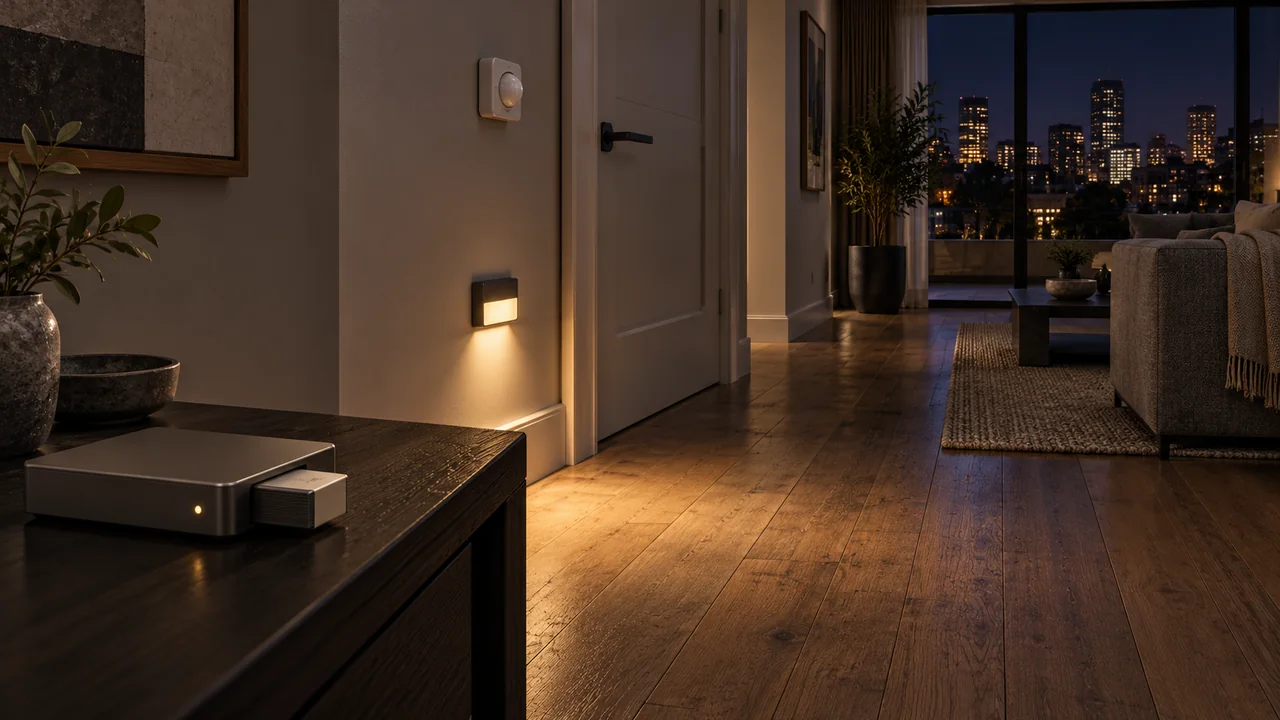
The question is not simply whether the room remembers, but what kind of memory it keeps. A preference is not a recording. A short-lived state is not an enduring profile. A local record is not the same as one available to a remote service. And deleting one item is not the same as resetting an entire system and hoping every trace went with it.
People should be able to see what the room kept, why it mattered, where it traveled, and when it will disappear. If the system cannot answer those questions, its continuity begins to look less like intelligence and more like opacity.
This is not only a speculative concern. NIST’s interviews with 40 smart-home users found varied and often unclear understandings of how household data was collected and used. A later NIST survey of 401 U.S. smart-home users found that participants viewed voice assistants as the most problematic of the five device categories studied.0809
Make the room’s memory visible in the Atlas →
Trace what a deletion request does—and does not—establish in the Atlas →
Editorial instrument / not a technical standard
Seven verbs.
Five negotiations.
An intelligent room is not a personality. These seven verbs are an editorial map of capabilities, decisions, and permissions.
- 01SenseReceive a signal
- 02InferAssign meaning
- 03RememberRetain context
- 04DecideSelect a response
- 05ActChange the space
- 06ExplainExpose the reason
- 07ForgetDefine expiry or deletion
- 01 / Attention
- What is the room allowed to sense, and when does sensing stop?
- 02 / Meaning
- Which interpretations may be made from a signal—and which are too uncertain or intimate?
- 03 / Continuity
- What may persist, for how long, and in a form visible to the people who live there?
- 04 / Authority
- Which decisions and actions can happen without a fresh request, and who can reverse them?
- 05 / Accountability
- Can the room explain itself, accept correction, and genuinely let a memory go?
03 / Shared space
A home does not have one user
Smart-home design often begins with an account and its primary user. Homes do not work that way. Partners share them. Children grow up in them. Guests visit. People come to clean, repair, deliver, or provide care. The person who bought the system is not the only person it affects.10
Return to the winter minute. The person at the door prefers a bright hall and warm rooms. The person in the kitchen lowered the lights to settle a headache and has been comfortable at a cooler temperature. A routine that recognizes the arrival perfectly can still choose badly. The conflict is not a sensor error. It is a policy question disguised as personalization.
Consent changes from room to room: at the front door, around the dinner table, beside a bed, and whenever one person leaves while another stays. A household setting can hide disagreement inside the household. A camera that feels acceptable at an exterior entrance may feel entirely different across a living room. A memory that helps one person may expose another.
If a room is going to call itself intelligent, it has to deal honestly with more than one person. It could show when a capability is active, limit what it infers when it is unsure who is present, or refuse to make a shared memory out of a private moment. Most of all, it should reveal disagreement rather than settle it silently for whoever controls the account.
Research on multi-user smart homes has reached the same boundary from the other direction. A 2019 in-home study tested location-based access, supervisory controls, and activity notifications across seven households. The results led the researchers to revise their initial design principles and identify continuing challenges where security, privacy, and ordinary household relationships meet.10
04 / Quiet interface
After the prompt
With a prompt, the exchange is easy to see: someone asks and the system answers. An ambient system works differently. It is meant to notice without being called, infer a need, choose a moment, and act. As the interface gets quieter, the judgment behind it matters more.
A quiet system still has an interface; it simply offers fewer obvious chances to consent. Without a button, request, or screen, timing becomes the message. A light that rises too early, a reminder spoken in front of the wrong person, or a door that behaves unexpectedly can expose the system’s assumptions through the trouble they cause.
That changes what success looks like. The goal is not to automate as many moments as possible. It is to know when to intervene, make the intervention clear, and let people understand or undo it.
Some of the pieces are beginning to meet. Google now describes Gemini for Home as a platform spanning devices, services, camera intelligence, and proactive features; Apple has documented a new generation of on-device foundation models, including a natively multimodal model; Matter 1.6 adds mechanisms for more context-sensitive control across ecosystems.060705 These are first-party capability reports, not evidence that a coherent intelligent room has arrived. Taken together, they suggest convergence at the component level while leaving the social contract unresolved.
There are practical reasons to want this. For someone with limited reach, mobility, vision, or energy, fewer trips to a switch or control panel can increase autonomy. A 2025 qualitative study with 25 disabled participants reported real benefits alongside continuing problems with reliability, complexity, and accessibility. A voice-only room can remove one barrier while creating another.1112
05 / Failure anatomy
When the room is wrong
An incorrect answer presented as information matters. A wrong inference connected to a lock, light, heater, camera, or moving machine can also change the physical world. Both can cause harm, but once a judgment acts on the room, the gap between inference and action becomes part of the safety design.
- Signal
The room received the wrong thing.
- Meaning
It received the right signal and interpreted it badly.
- Memory
It relied on context that was stale, misplaced, or belonged to someone else.
- Authority
Its interpretation was reasonable, but it had no permission to act.
- Recovery
The action could not be understood, reversed, or prevented from repeating.
No room built from incomplete signals and changing human situations will be right every time. The real test is what happens after a mistake: how much harm it can cause, how quickly it can be undone, and whether the person affected can understand it without becoming the system’s technician.
06 / Restraint
The smartest room may be the one that waits
In the two works discussed here, ambient intelligence feels impressive because it seems continuous and acts before a person asks. But anticipation is only one kind of intelligence. Restraint is another.0102
A room that can express uncertainty, seek confirmation, or do nothing may feel less magical. It may also be more compatible with ordinary human life, where intentions change, habits break, and several reasonable preferences can occupy the same space. The pause before action is not necessarily a failure of automation. It can be the place where another person remains visible.
A better demonstration would ask less about how many tasks the room can perform and more about whether it knows the edge of its authority. Do not count only the taps removed; count the work required to inspect, correct, and leave. The off switch should not look like a concession. It should be one of the room’s most carefully designed objects.
07 / Exit
The exit should be architecture
We often picture the intelligent room as a familiar space with an invisible layer over it. Its limits should be easier to see and touch. A physical control can show that sensing has stopped for the devices it governs. A visible ledger can show what the system retains. A per-item control can make a deletion request specific. A local mode can make the network boundary legible. These are not administrative settings tacked onto the experience. They are part of the room.
A deletion receipt is useful only if it says exactly what was removed—and what was not. It may confirm that an event disappeared from the visible log while backups, shared copies, derived profiles, or prior model updates remain elsewhere. To call something “forgotten,” the system needs to name the object, the location, and the limit. The same honesty matters when a resident moves, a home changes ownership, or a vendor stops supporting the product. NIST’s current IoT guidance treats support through end-of-life as part of the product’s cybersecurity foundation—not an optional afterthought.13
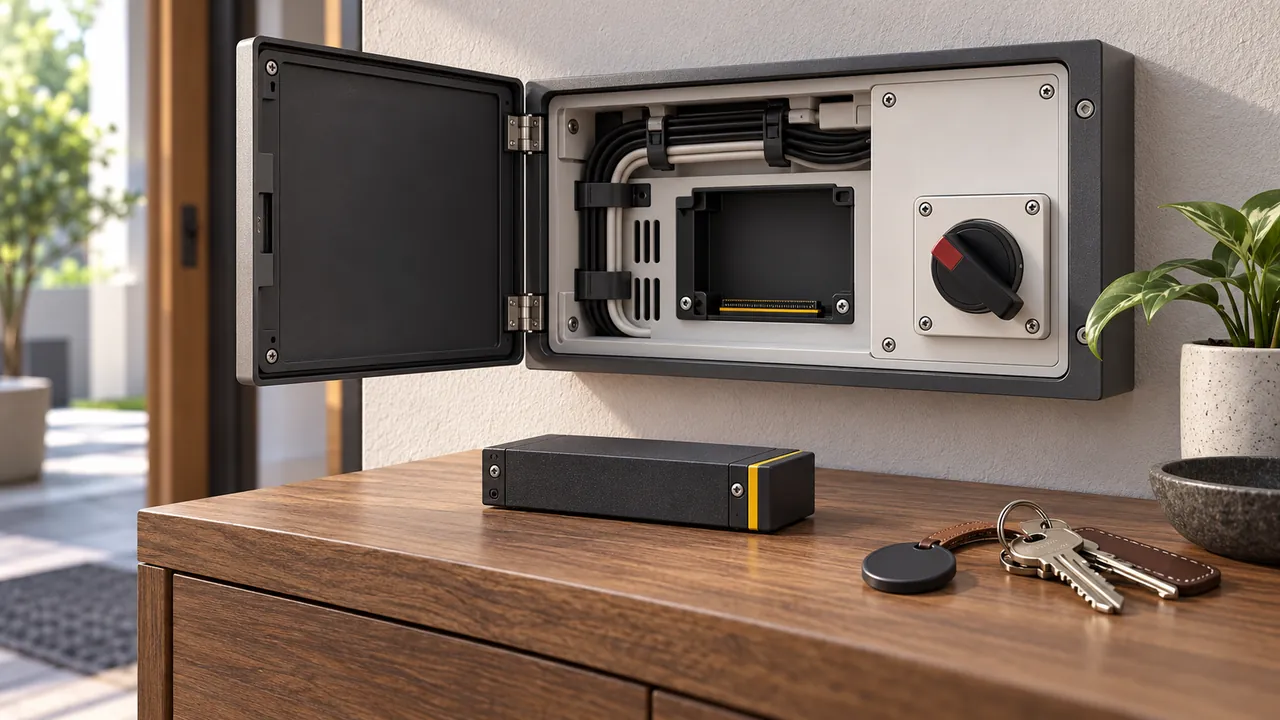
An occupant should not need forensic expertise to understand whether a system is active or whether it will remember. The route out should remain available to the guest, the next owner, the person who did not configure the system, and the person whose needs have changed. Departure is not an edge case in a home. People move, relationships change, services shut down, products lose support, and rooms acquire new lives.
The goal is not to make technology disappear. Assistance can fade into the background, but accountability should remain in view. The walls may notice. The people inside should still be able to notice the system back.
Evidence shelf / sources checked 12 October 2026
The room’s visible foundations.
These sources support specific historical and present-day claims. Vendor sources establish what their authors released or reported; they do not independently establish reliability, adoption, or social benefit.
- 01 / Cultural work2001: A Space Odyssey
American Film Institute catalog record; release date and production record.
Read the AFI record ↗ - 02 / Cultural workSmart House
Disney catalog record; 1999 release and official synopsis.
Read the Disney record ↗ - 03 / Research lineageThe Computer for the 21st Century
Mark Weiser, Scientific American, September 1991. DOI: 10.1038/scientificamerican0991-94.
Open the publication record ↗ - 04 / Research prototypeDesign Principles for Intelligent Environments
Michael H. Coen, MIT Artificial Intelligence Laboratory, AAAI-98.
Read the paper ↗ - 05 / StandardMatter 1.6
Connectivity Standards Alliance, 17 June 2026. Official release description; product adoption may lag the specification.
Read the release notes ↗ - 06 / Vendor reportEmpowering Service Providers and Hardware Partners with Gemini for Home
Google Developers Blog, 21 May 2026. Used only for Google-reported platform capabilities and availability plans.
Read the platform report ↗ - 07 / Technical reportIntroducing the third generation of Apple Foundation Models
Apple Machine Learning Research, 8 June 2026; updated 9 September 2026. First-party architecture and evaluation report.
Read the technical report ↗ - 08 / User researchResearch Report: User Perceptions of Smart Home Privacy and Security
NIST IR 8330, November 2020; interview study with 40 smart-home users.
Read the NIST report ↗ - 09 / User researchSurvey on Smart Home Users’ Security and Privacy Perceptions and Actions: A Device Category Perspective
NIST SP 1343, December 2025; U.S. survey of 401 smart-home users.
Read the NIST report ↗ - 10 / In-home studyUnderstanding and Improving Security and Privacy in Multi-User Smart Homes: A Design Exploration and In-Home User Study
Eric Zeng and Franziska Roesner, USEN Security 2019; month-long study with seven households.
Read the paper ↗ - 11 / Qualitative studyUser-informed recommendations for enhancing smart home services among people with disabilities
Assistive Technology, 20 October 2025; qualitative study with 25 disabled participants. DOI: 10.1080/10400435.2025.2573676. Small-sample findings are not treated as population estimates.
Open the article record ↗ - 12 / Exploratory working materialVoice agent user requirements
Draft W3C accessibility needs, requirements, and discussion material—not a W3C Recommendation. Used to frame multimodal access questions, not product performance or conformance.
Read the working material ↗ - 13 / Lifecycle guidanceFoundational Cybersecurity Activities for IoT Product Manufacturers
NIST IR 8259 Revision 1, April 2026; lifecycle support and end-of-life guidance.
Read the NIST report ↗
Editorial status / bounded public preview
The internal source and copy audit for this feature is complete. Its lived-house visuals have exact provenance records and automated QA, and the owner originally authorized a search-blocked public preview after a documented, AI-assisted publication-risk review. Search availability was subsequently authorized on 26 October 2026. Independent human fact, media-rights and provenance, likeness and product-trademark, and disability-led review remain pending. The room sequences and household situations are conceptual examples. The feature was developed with material AI assistance and remains under Artificially.cloud editorial responsibility. Fiction is not evidence of prediction, feasibility, causation, or technical lineage; documented cultural references are identified separately. Research horizons elsewhere in the exhibition are open monitoring questions—not predictions, and not estimates of this site’s development schedule.