

Threshold / Sense → Infer
The door opens. That is all the threshold knows.
A door contact reports one change; motion may suggest that someone is there.
Calling it an arrival—and deciding who arrived—means combining separate signals into a story.
Published recordAs of
Atlas / Concept 004 / Ambient intelligence
Home & relationships
Interfaces & augmentation
Selected fiction imagined a mind in the walls. The present is a room full of partial senses. This exhibition opens the walls.
Framing questionWhen does a helpful environment become an observing one?
House route / Stop 01
City edge · one household · browser exhibition
This is not a tour of imaginary gadgets. It begins with an ordinary house, then follows what its systems can sense, infer, remember, control, and explain. The last stop separates equipment that exists now from the combinations that remain a five-year scenario.
01 / Room Observatory
Interactive architectural study · renderer 01
The intelligence is scattered across sensors, models, memories, house rules, devices—and the people who live with them. Choose a verb to see what has to happen, and what the room should reveal, before we call it intelligent.
Stress-test the promise
Our starting room assumes one person, one vendor, and a working internet connection. Real homes rarely stay that simple. Change the conditions.
The room picks up sound, motion, light, temperature, and device state.
Those signals become guesses: occupied, familiar, likely, unusual. Identity is a conclusion, not something a sensor simply sees.
Events, preferences, and profiles can linger—often without a clear view of what was kept or how to change it.
A person, rule, or model chooses: act, ask, wait, or do nothing.
A permitted command changes what people see, hear, feel, or can access.
People should be able to see what happened, why it happened, and who or what had permission.
Deletion needs a clear target and limit. A receipt can confirm an action, but not that every copy—or every learned effect—is gone.
We use seven verbs to read the room. They are not a literal flowchart: real systems loop, revise, and let one action become the next signal.
H02 / Lived-in fieldbook
Six scenes from one imagined household · one ordinary night
The full-scale view places the technology in an actual neighborhood. These close views show where it touches ordinary life: at the front door, across a shared kitchen, at the table, and inside the household record.
Threshold / Sense → Infer
A door contact reports one change; motion may suggest that someone is there.
Calling it an arrival—and deciding who arrived—means combining separate signals into a story.

Shared kitchen / Remember → Decide
One resident likes a bright hall. Someone already at the table wants the kitchen dim.
Both facts can be true. The system still has to decide whose comfort wins—or stop and ask.
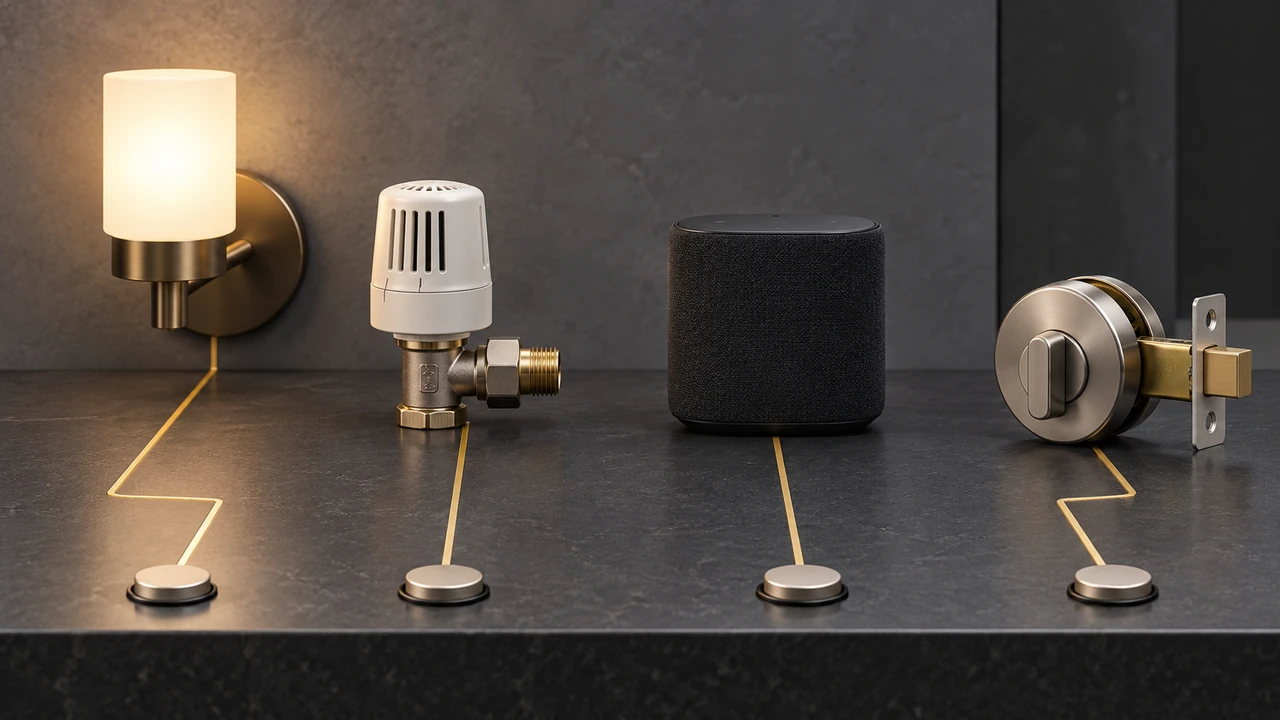
Across the house / Act
Light, heat, media, and a lock each receive their own instruction.
Calling that “the room” hides the important part: every device can fail on its own, needs its own override, and leaves someone to deal with the result.
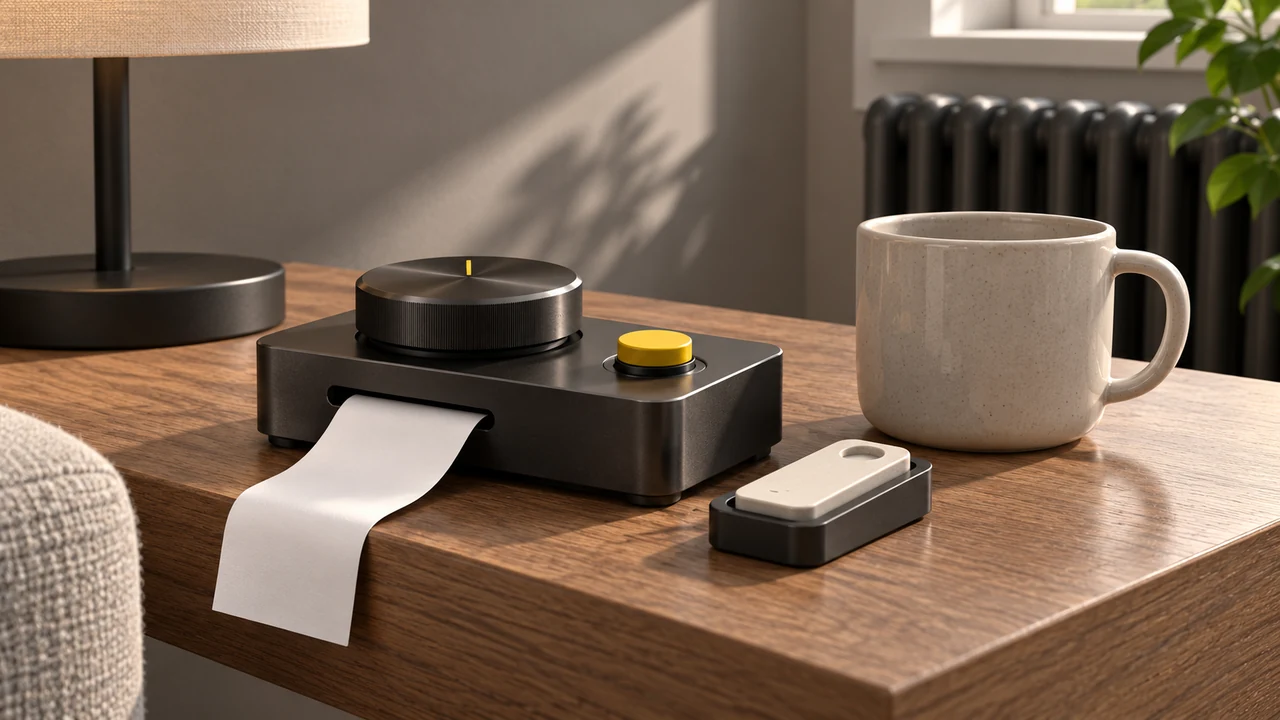
At the table / Explain
The explanation should survive the app.
A useful receipt would say what set the change off, which rule fired, what changed, and who authorized it. You should not have to hunt through someone else’s account menu to understand your own room.
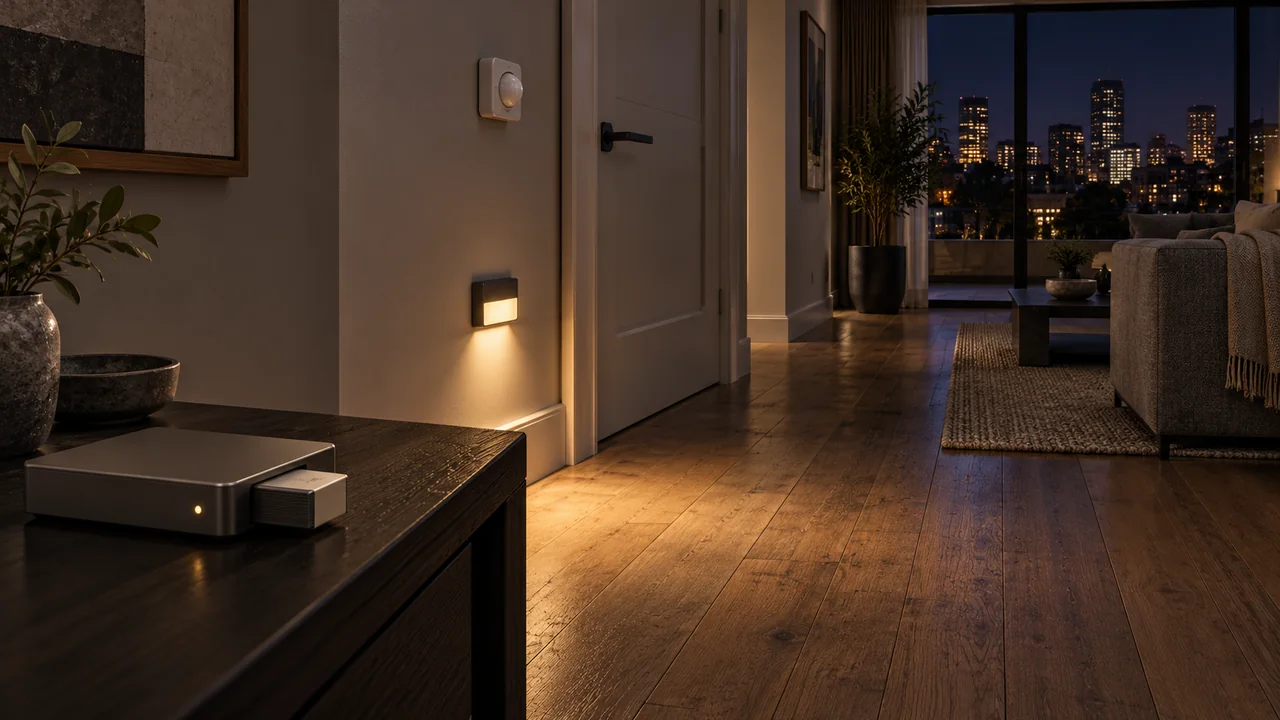
Night hall / Sense → Remember
Walking down the hall is ordinary. Keeping a record of it is a choice.
A sensor may register a crossing. It does not know why it happened. The harder question is whether that moment should enter the household’s history—and for how long.
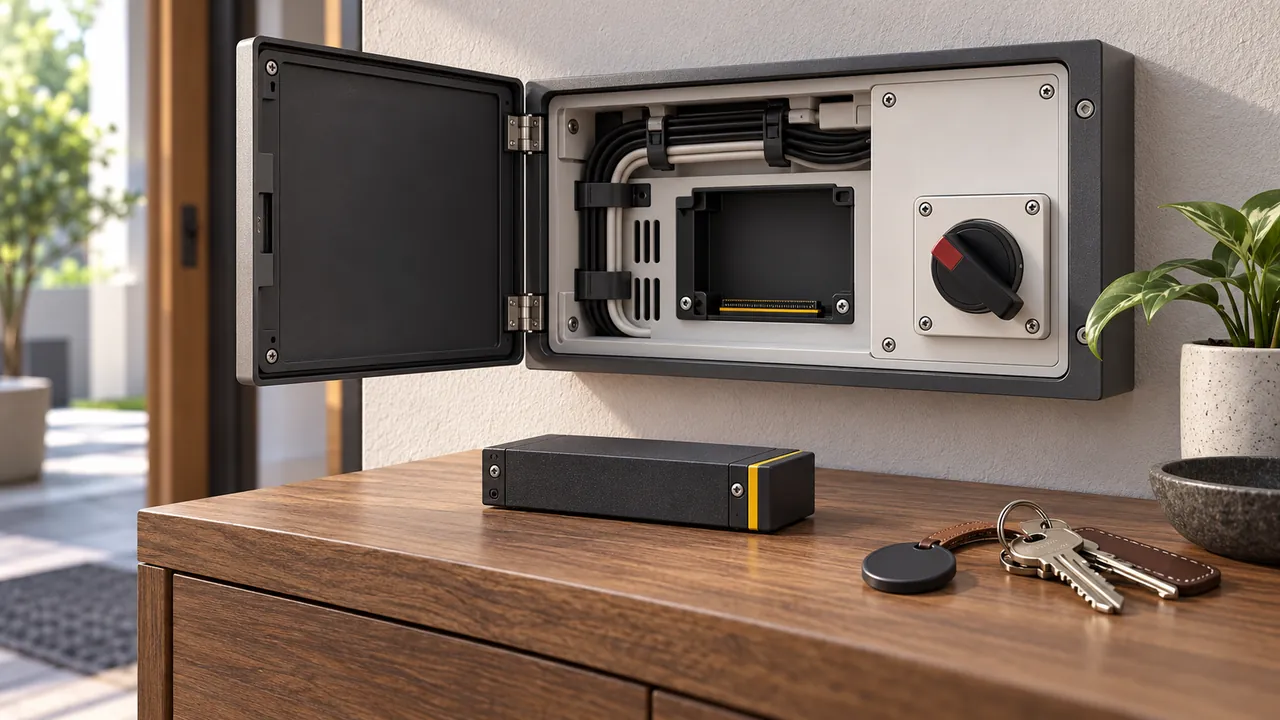
Utility wall / Explain → Forget
Turn it off. See what it kept. Delete the event. Know what deletion cannot promise.
Stopping the system and deleting its memory are different acts. A receipt can confirm that a named record was removed. It cannot prove that every copy—or every influence on a model—is gone.
02 / One minute, opened
Interactive event choreography · illustrative household sequence
The feature begins with a room appearing to welcome someone home. Open that minute and the seamless gesture separates into signals, inferences, retained context, policy, commands, and consequences.
What it feels like
“The room welcomed someone home.”
One quiet gesture. No visible request.
60seconds
opened
Trace at rest. The complete sequence remains readable below.
Signals suggest activity in two places. Signals are not identities.
Responsible components · occupancy and audio sensing Open the sensing boundaryEvents are joined to a routine. This exact chain is not established by the sources.
Responsible component · hub or automation service Open the present assessmentThe system assigns meaning. “Familiar” is an inference, not an observation.
Responsible component · rule or model Inspect InferA scenario preference appears. What was retained—and where?
Responsible component · profile or routine store Inspect RememberThe returning preference conflicts with the room already in use. Whose rule applies?
Responsible component · household policy Open the shared-room conflictSeparate commands leave the controller. Coordination does not supply judgment or consent.
Responsible components · hub and device interfaces Read the Matter 1.6 profileThe room changed. The reason, scope, and override should remain visible.
Responsible component · accountable interface Inspect Explain04 / Local until it is not
Interactive boundary plate · documented fragments, not one product
A feature can run locally while the rest of the chain reaches elsewhere. Follow the cuts to see where the evidence holds—and where we simply do not know.
Path A / Documented local
Apple documents on-device models. Google documents local execution for some automations. These are separate records, not one pipeline.
Path B / Disclosed remote component
Apple documents three server-based models running on Private Cloud Compute. Apple’s PCC requirements say request data must not be retained, including through logging or debugging, after a response; this is a vendor-stated boundary, not an independent audit or a feature-routing map.
Path C / Unstated
Google’s Gemini for Home report lists devices and services but does not state execution location, network dependency, offline behavior, or fallback for its named AI capabilities. Matter coordinates supported components; it does not supply one universal local/cloud architecture. Other unstated processing, account, telemetry, retention, and fallback boundaries remain unknown.
05 / The memory residue
Interactive deletion-path study · proposed safeguard
Deleting one named record is not the same as erasing every trace. This diagram follows an illustrative request and marks what the receipt can—and cannot—prove.
All objects and uncertainties are shown. Trace the request to emphasize its named boundary.
Requested outcome: remove from the named visible-history store.
Illustrative target · not proof of storage architectureA related preference is a separate object. This diagram does not assert that one event created it.
Outcome not establishedRemoving an event does not establish that a resident or household profile changed.
Outcome not establishedNo specific influence is established. The dotted path asks whether one exists and whether it can be reversed.
Existence and reversibility unknownAn accountability record would have its own purpose, access, and retention boundary.
Separate recordA receipt can report the named action. It cannot, by itself, prove what happened to backups, shared copies, profiles, or learned influence.
Proof limited to stated scopeA reasoning diagram—not a deletion guarantee. This is not a product trace, vendor architecture, legal determination, or claim that every pictured object exists in a named system.
Current evidence supports a narrower conclusion: local inference does not establish that telemetry, logs, backups, or outputs remain local; smart-home research documents users’ varied and sometimes unclear understanding of how household data was collected and used; lifecycle guidance makes end-of-life support a product concern.
Artificially.cloud’s notice describes this website’s own request-data boundary. It is not evidence about a household product.H03 / Five-year house
A conditional 2031 field study · evidence window 16 Oct 2026
Five years is close enough that the studs, the budget, and the service call still matter. This is the same 3,500-square-foot house at the edge of the city—not a lab and not a billionaire compound. Most of it is ordinary. The speculative step is that real components begin to coordinate locally, explain what they did, and give way when someone disagrees.
A component or capability can be bought, deployed, or used now, though access and quality vary.
Real standards, products, or research systems exist; ordinary household availability is not established.
A conditional design extrapolation for this exhibit—not an issued forecast, promised arrival date, or product claim.
01 / The working edge
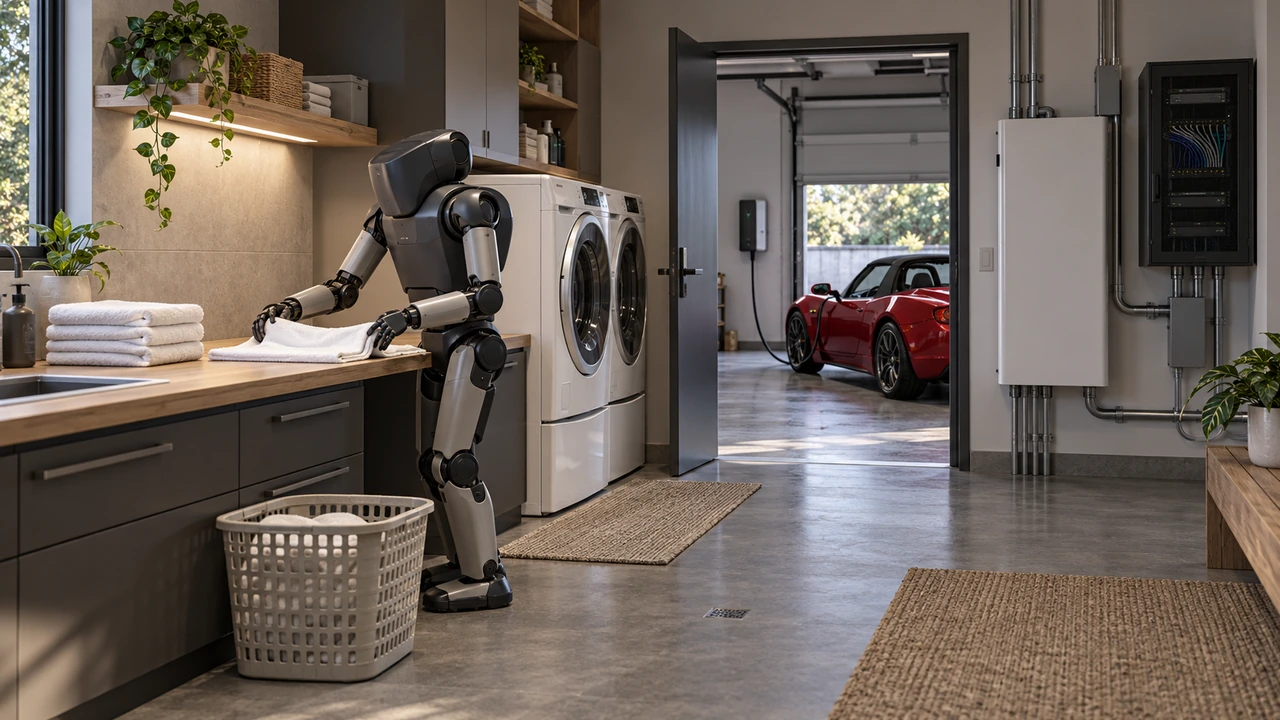
A single mobile robot shares the utility room with the systems that make the house work: heat pump, filtered air, water isolation, battery, wired network, local compute, and the old shelf where spare parts accumulate. In the garage, the Roadster charges like a car—not like a magic battery for the building.
Boundary: The robot is a five-year extrapolation from research systems, not a claim of safe unattended domestic competence. The Roadster is not shown powering the house; bidirectional support for that exact vehicle and installation would have to be verified.
RoomHeadset off
ViewInside the headset
02 / Spatial room
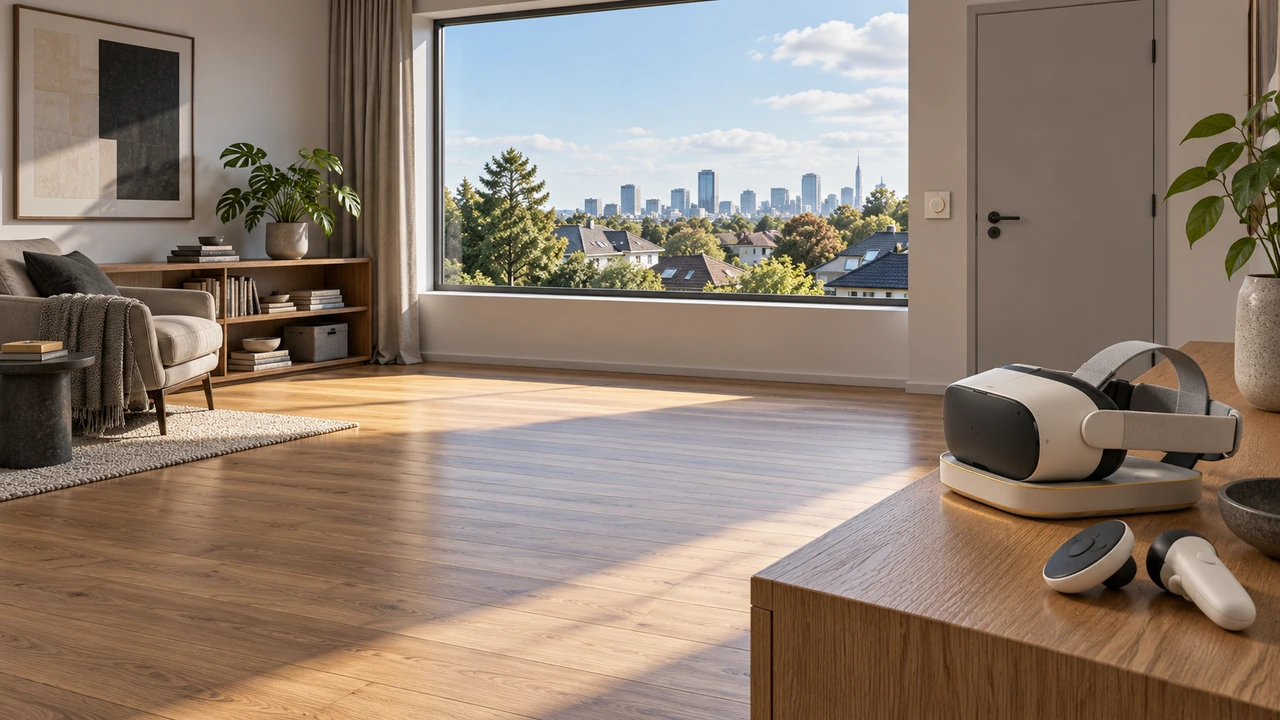
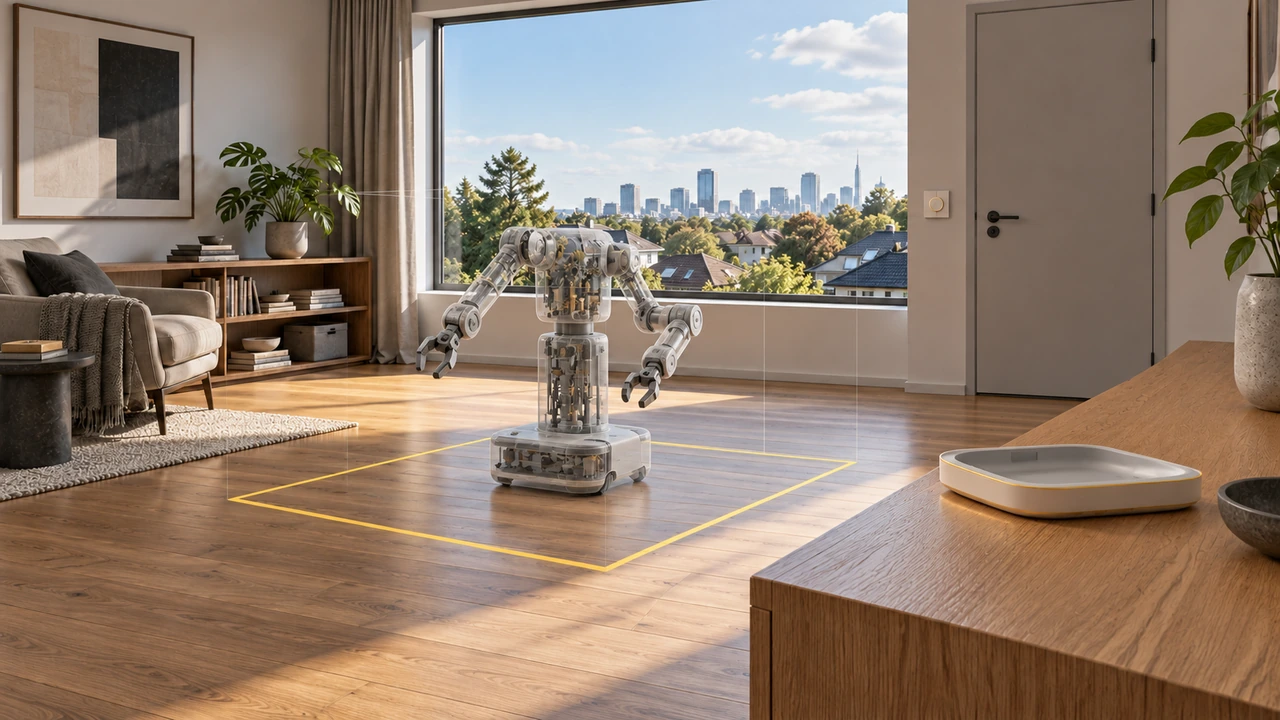
Most days it is a spare room with a reading chair and somewhere to put your books. Put on the headset and a digital model of the household robot could appear in the clear floor area, ready to inspect without moving the real machine. The door, seating, and physical controls still matter. Someone should be able to interrupt, and taking the headset off should be enough to return to the room.
Boundary: Headsets and immersive media exist now. A socially graceful room that coordinates lighting, sound, safety, and household interruption is the forecast layer. No headset pose, room scan, or bystander recording should enter the household memory by default.
H03 / Evidence register
The image is a synthesis; the evidence is not. Each entry names what is real, what is still uneven, and the line this house does not cross.
Research robots can already chain manipulation tasks such as collecting and folding laundry. Here, one shared machine works in the utility room instead of following people through every room.
A robotic mower follows a mapped work area while drip irrigation responds to weather and several soil readings. The lawn still has thin spots, leaves, and edges a person has to trim.
High-resolution stereoscopic video, spatial audio, hand tracking, passthrough, and room-scale experiences are available. The house adds the unglamorous pieces: clear floor space, a seated mode, a visible dock, washable face interfaces, acoustic control, and a physical way out.
Apple Immersive Video technical overviewW3C WebXR Device APIApple Vision Pro privacy overview
Fixed voice commands can run on modest local hardware; larger on-device models are arriving in consumer systems. The utility cabinet gives them power, cooling, storage, and an ordinary network cable.
Home Assistant local voice documentationApple on-device model research
Matter and Thread let more controls, sensors, locks, energy devices, cameras, and appliances describe themselves across ecosystems. Two border routers keep the low-power fabric from depending on one box.
Connectivity Standards Alliance: Matter 1.6Thread 1.4 feature paper
A home battery, heat-pump water heater, smart panel, solar inverter, and managed charger shift flexible loads without making the resident decode a utility tariff at dinner.
U.S. DOE managed and bidirectional chargingTesla Powerwall operationTesla charging during an outage
Particulate, carbon-dioxide, temperature, and humidity trends can change ventilation and filtration. Flow monitoring, point sensors, and a motorized main valve can catch some leaks before the basement becomes the story.
U.S. EPA low-cost indoor-air monitorsU.S. EPA leak and flow-monitoring guideMatter 1.3 water and energy devices
Camera shutters, microphone power cuts, room-level permissions, local-only indicators, tactile switches, and a mechanical key sit where residents and guests can actually find them.
NIST IR 8259 Rev. 1Connectivity Standards Alliance: Aliro 1.0Apple accessibility features
An opt-in bedside radar can estimate sleep and movement without a camera. A later system might notice an unusual fall-like event and ask before escalating to a named person.
Google Research sleep/wake radar studyPrimary mmWave activity and fall study
The induction range, hood, air system, washer, dryer, dishwasher, refrigerator, and water heater can expose state and energy use while retaining physical controls.
Matter 1.2 appliance supportMatter 1.3 kitchen, laundry, and energy support
Fiber, Ethernet, a PoE switch, local storage, a small AI appliance, UPS, ceiling access points, and Thread border routers make the network a serviceable part of the building.
An enclosed desktop printer makes jigs, cable guides, adapters, and low-risk replacement parts. Electrochromic glazing and a matte e-paper panel quietly manage glare and household information without turning every surface into a screen.
NIST additive-manufacturing qualification reportU.S. DOE electrochromic window overviewE Ink Spectra 6
06 / Time Spine
Filter by time, then choose an entry to open its Evidence Margin. Keyboard: Tab enters the chronology; arrow keys move between visible entries. Everything is also readable in the list view.
These are the dates when works appeared or events happened. They do not move as the present moves.
This is what the evidence showed on 12 Oct 2026. It will age.
These are review dates, not promises about what arrives. No outcome, probability, or website timeline is forecast here.
07 / Comparison Shutter
Use the buttons to line the two readings up or pull their differences apart. The full comparison stays readable as text.
The rows align categories for inspection. Alignment does not make the imagined and observed systems equivalent.
Imagined / Editorial composite under review
| Function | Continuous assistant and mediator |
|---|---|
| Capability | Conversation, memory, planning, action |
| Mechanism | Presented as a unified intelligence |
| Oversight | Often implicit or centralized |
| Social context | Everyday dependence is normalized |
Observed / Editorial composite under review
| Function | Separate assistants, sensors, routines, and devices |
|---|---|
| Capability | Strong in narrow tasks; continuity varies |
| Mechanism | Fragmented models, services, and control layers |
| Oversight | User-configured, vendor-governed, inconsistently legible |
| Social context | Trust, privacy, reliability, and household negotiation remain unresolved |
08 / Horizon Window
These dates are for returning to the evidence, not predicting an arrival. Each horizon names what would strengthen the case and what would weaken it. Any future forecast would go through a separate documented review.
Current posture
09 / Source Room
This register gathers the sources the exhibition depends on most. We checked them against current primary or authoritative records; independent fact-checking and final editorial review are still required before publication.
What we still do not know
10 / Reading Room
The Intelligent Room is one exhibition and one editorial issue. Each story enters the same system from a different human question.
A field guide to hidden seams, domestic memory, and the boundary between help and observation.
Read now ↗How sensing becomes judgment—and judgment becomes architecture.
In developmentGuests, children, workers, and the fiction of shared permission.
In developmentDeletion, deactivation, resale, portability, and the right to pull the plug.
In development