Does one deployment survive another job?
Look for named workflows, intervention rates, operating hours, failures, maintenance, and customer-confirmed results—not a new demonstration reel.
Published recordAs of
Embodied intelligence / The Working Body
A century after fiction invented the universal artificial worker, the body is real. Universality is not.
Dated assessment
Industrial deployment: credible
General human-like usefulness: not established
01 / Thesis
Worker ≠ person
What became real
Start with the job below, then follow what the body can do, where it fails, and the evidence behind it.
A robot can now walk into a live warehouse and move a known container between two known systems. That is consequential. It is also a much narrower achievement than the artificial worker fiction taught us to picture: one body, any task, any room.
Useful embodiment is an arrangement, not an object. The floor is mapped. The tote is standardized. The path is cleared. Charging, networking, fleet software, safety controls, and human recovery are already waiting. The machine’s body matters; so does everything the building agrees to become around it.
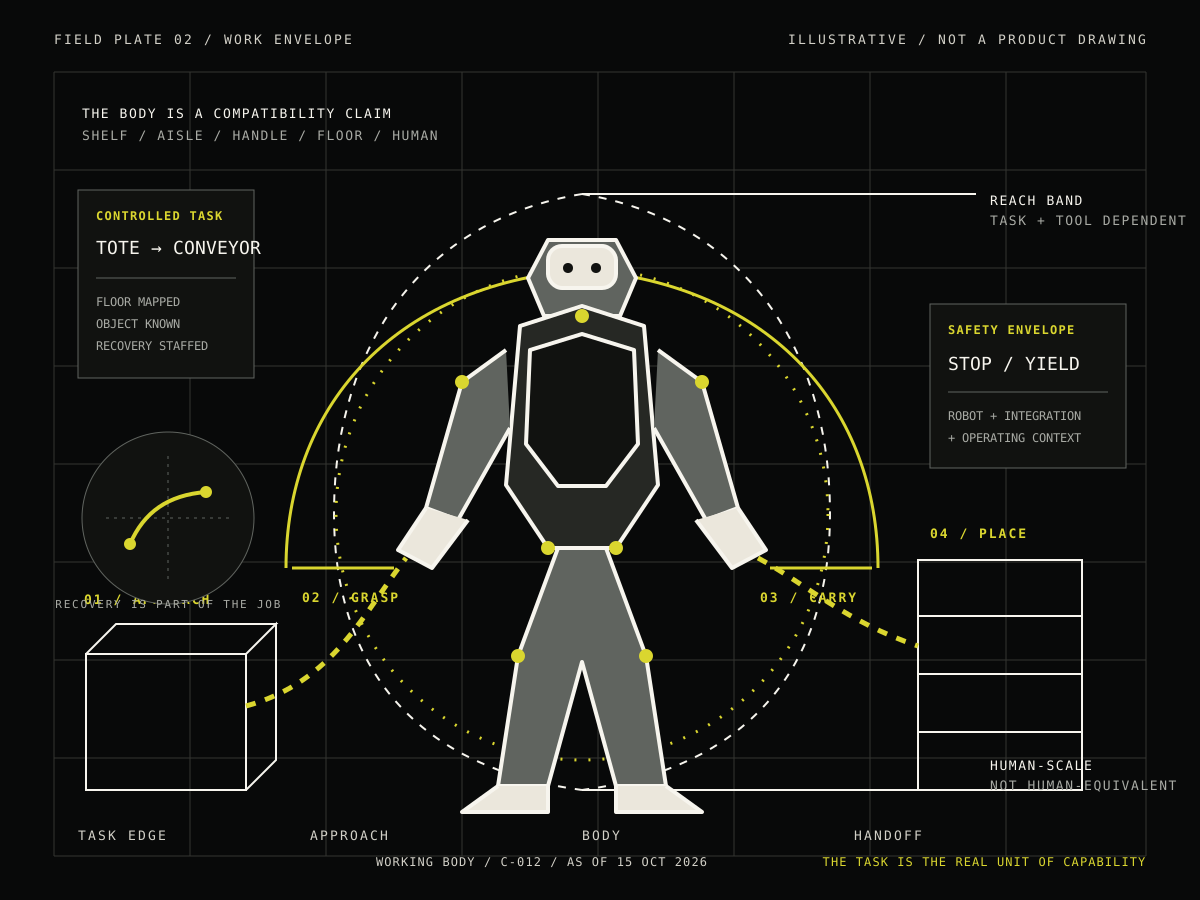
Long description: A generic human-scale body stands between a tote at the left and a conveyor at the right. The transfer path is labeled approach, grasp, carry, and place. Curved bounds show that reach depends on the task and tool. Notes state that the floor is mapped, the object is known, and recovery is staffed; a separate safety envelope includes the robot, integration, and operating context. The body is human-scale, not human-equivalent. The plate is illustrative and carries no physical scale.
The plate is an editorial instrument, not a likeness, vendor architecture, safety diagram, or product specification.
02 / Now cut
Five facets
Dated realization assessment
No single maturity score can describe a machine that walks reliably, grasps selectively, generalizes unevenly, and still depends on a carefully integrated operating envelope.
The complete unit of capability
A polished demonstration can prove a motion. Productive work demands a repeatable sequence, including what happens after the object moves, when the aisle changes, or when the robot cannot continue.
Locate the object, destination, people, and changing obstacles.
Reach a usable pose without collision, instability, or blocked traffic.
Apply the right geometry and force to the right object.
Preserve balance and object control through the route.
Hand the object to the next person or automation system.
Stop, explain, retry, or yield when the sequence breaks.
03 / Failure
Physical stakes
The part demos crop out
An incorrect word can mislead. An incorrect motion can drop a load, block an aisle, damage equipment, or place a person inside a machine’s stopping distance. Embodied intelligence joins model error to mass, momentum, and the architecture of a real workplace.
That is why recovery belongs inside the capability claim. A system that completes nine steps and strands the tenth is not merely less intelligent than expected; it changes the job of everyone who must notice, diagnose, reset, clear, and resume the process.
04 / Chronology
1920 → Now
A worker, narrowed into reality
Fiction provides the comparison. Research and deployment records establish what happened. Resemblance does not establish prediction, influence, or technical lineage.
Karel Čapek’s play makes artificial labor an industrial system. Its workers are synthetic organic beings—not present-day robots.
Source 01General Motors records Unimate handling hot die-cast parts: dangerous, repetitive work inside a highly structured cell.
Source 02Honda announced ASIMO as a compact humanoid developed around walking within human living environments.
Source 03QT-Opt reported large-scale physical grasp training and strong results inside its experimental setup—not general dexterity.
Source 04Open X-Embodiment assembled data from 22 robot embodiments and reported positive transfer in RT-X experiments.
Source 05GXO documented Digit moving totes from mobile robots to conveyors. Agility’s later generation record identifies its earlier customer deployments as Digit 4.
Source 06Source 11Current evidence supports industrial credibility in bounded work. It does not establish an unrestricted artificial worker.
EvidenceResearch windows / questions, not forecasts
These windows organize future editorial checks. They state no predicted outcome, probability, product schedule, or estimate of when a general robot will arrive.
Look for named workflows, intervention rates, operating hours, failures, maintenance, and customer-confirmed results—not a new demonstration reel.
Compare bodies, facilities, objects, integration effort, safety cases, and recovery practices using the same measures.
Ask whether one deployed body performs materially different workflows without hardware replacement or hidden facility redesign.
Track how automation redistributes supervision, maintenance, risk, skill, bargaining power, and responsibility rather than treating adoption as destiny.
05 / Evidence
11 records
Visible foundations
Vendor and customer records establish what their authors report. They do not independently establish general capability, broad adoption, workforce outcomes, or safety in a different application.
Continue the exhibition
Story — Read “The robot gets a job description” →
Technology — Inspect Agility Digit + Arc →
Atlas — Return to The Intelligent Room →
This review fixture was developed with material AI assistance and remains prototype-only. Independent human fact, rights, accessibility, and publication review are pending.