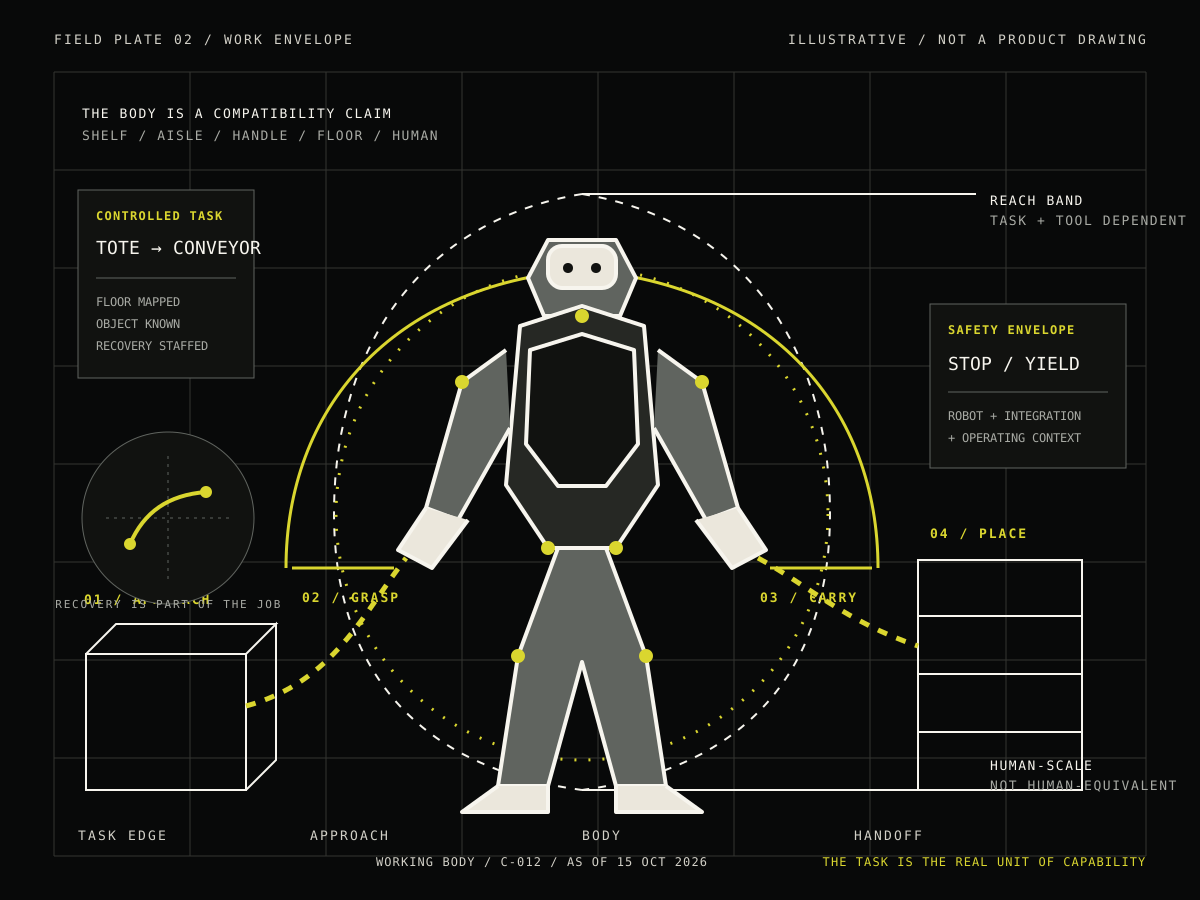
A tote arrives on a mobile cart. A bipedal machine walks toward it, closes two grippers around the plastic rim, turns, crosses a marked patch of concrete, and places the tote onto a conveyor. The movement looks short. The description of the job takes a page. This reconstruction interprets the published workflow; it is not a timestamped observation of a specific shift.
The floor must remain inside the machine’s operating conditions. The tote must arrive where the robot expects it, within the shape and weight its grasp can manage. A fleet system must know when the cart is ready. The conveyor must be available. Charging, wireless connectivity, maintenance, safety controls, exception handling, and a person able to intervene all sit just outside the frame.
That outside is the most interesting part of embodied intelligence. A humanoid silhouette suggests universality before the first task begins: hands for our tools, legs for our stairs, height for our shelves. Yet the documented work of present machines is useful precisely because it is narrower. In GXO’s published description of a live warehouse deployment, Agility Robotics’ Digit moves totes from other mobile robots to conveyors.06 Agility’s later generation record identifies those earlier customer deployments as Digit 4; Digit 5 had been announced, but its availability remained forward-looking at this feature’s cutoff.10 It is a real job. It is not every job.
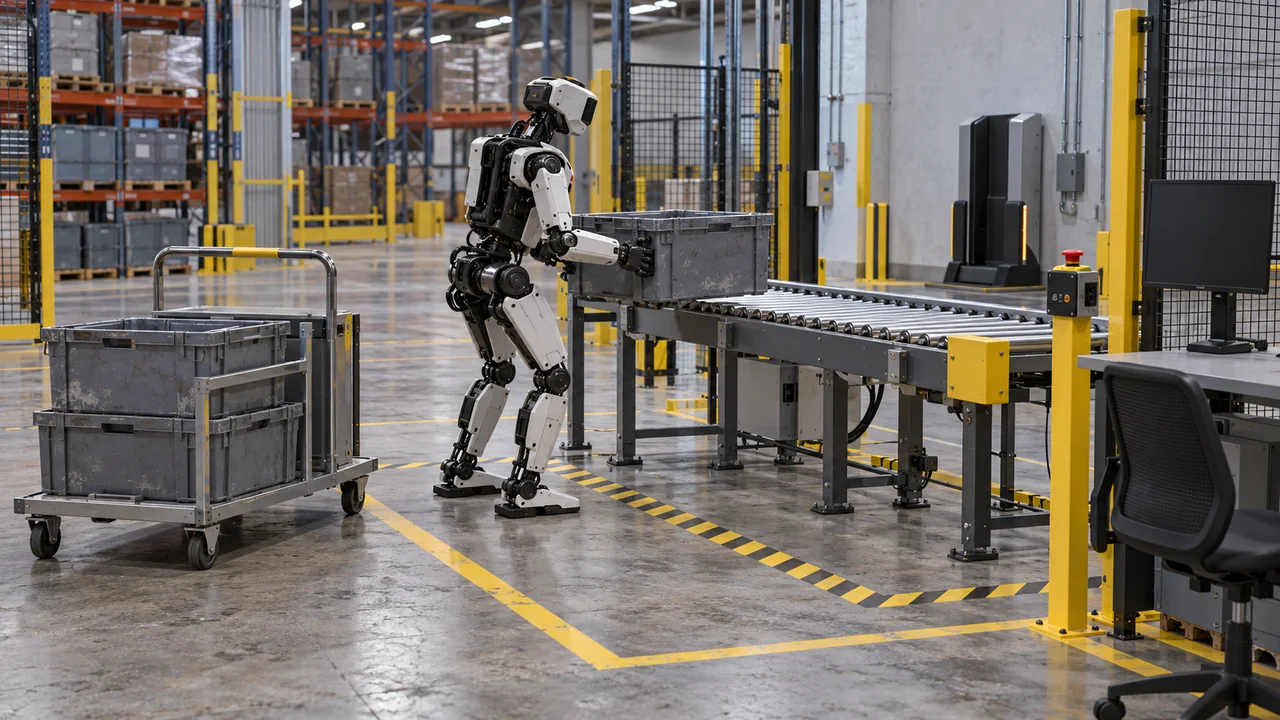
The difference between those two statements is where the future of the field will actually be measured.
The body looks general. The job is an agreement with the world.
01 / The inherited shape
A body is a compatibility claim
Human spaces are full of decisions made to fit a particular body. Door handles sit within reach. Steps expect a certain stride. Aisles, worktables, bins, tools, carts, and shelves encode assumptions about height, grip, vision, strength, and balance. A machine built on a roughly human scale can approach that accumulated infrastructure without asking every building to start over.
Honda made this ambition explicit when it introduced ASIMO in 2000. Its announcement described a compact humanoid developed around walking in the realm of human living environments.03 The body was not decoration. It was an argument about where the machine might fit.
But compatibility is not equivalence. Two arms do not guarantee a useful grasp. Two legs do not guarantee a safe route. A head-height sensor does not produce human perception, and a human-scale footprint does not make the machine socially or technically ready for every place a person can enter. The shape lowers some barriers while bringing every difference in control, sensing, power, recovery, and judgment into the room.
02 / Duration
A demonstration ends before the shift does
A successful grasp proves that a machine can complete a motion under the conditions shown. A useful deployment must answer different questions. How often does the grasp fail? What changes under different lighting, tote wear, floor friction, traffic, network conditions, or battery state? How much human time is spent staging the work, clearing exceptions, maintaining the machine, and restarting the line?
Robotics research has made the motion itself more adaptable. QT-Opt used more than half a million physical grasp attempts to train a closed-loop visual policy and reported strong performance on unseen objects inside its experimental setup.04 Open X-Embodiment later assembled datasets across 22 robot embodiments and reported positive transfer across platforms.05 These are important changes in how skills can be learned and shared.
Neither record eliminates context. A benchmark measures what it defines. A deployment succeeds or fails amid everything the benchmark cannot hold still. That is why the honest unit of capability is not the most impressive moment in the sequence. It is the completed task, over time, including interruptions and recovery.
03 / Fictional lineage
The universal worker arrived first in language
Karel Čapek’s 1920 play R.U.R. (Rossum’s Universal Robots) did not describe today’s machinery. Its workers are manufactured synthetic beings, and its concerns are industrial, economic, and political. The useful comparison is therefore not mechanical resemblance. It is the premise that artificial labor can be made as a repeatable class of worker rather than as a singular machine.01
Reality took another route. An early durable industrial pattern was not a universal body but a fixed machine inside a controlled cell. General Motors records Unimate entering its manufacturing operations in 1961 to handle extremely hot die-cast parts.02 The robot became valuable by separating a hazardous, repetitive motion from the rest of the factory.
Present humanoids are not a reversal of that lesson. They are a test of how much useful variation can fit inside one mobile body without sacrificing the discipline that made earlier automation dependable. The important question is not whether a machine looks able to do many things. It is how many materially different tasks it can complete, at operating quality, before the surrounding world has to be rewritten for each one.
04 / Safety envelope
Safety belongs to the application
A robot does not enter an empty room. It enters a system of work: people, aisles, vehicles, emergency procedures, loads, schedules, maintenance, and management. NIST’s human-robot interaction program treats trust and safety, shared-workspace tracking, interfaces, risk, and implementation as measurement problems for developers, integrators, and end users.08
That system-level view matters because intelligence can widen the range of situations a machine attempts without removing mass or momentum. A learned system may identify objects, plan a route, and select an action. The application still needs limits, detection, stopping behavior, access control, testing, and a response when the machine’s judgment no longer matches the physical world.
OSHA’s robotics material notes that many incidents occur during programming, maintenance, testing, setup, and adjustment—the moments when a human is near the machinery because ordinary operation has already stopped being ordinary.09 Recovery is not the embarrassing remainder after autonomy. It is one of the main ways autonomy meets the people asked to live with it.
05 / Infrastructure
The facility is part of the machine
Agility describes Arc as the platform that maps facilities, defines workflows, manages deployed robots, and supports troubleshooting.07 Those functions are not secondary to the body. They are how a machine with legs becomes an operating service rather than a self-contained object.
This is the hidden economy of generality. A body that can use existing aisles may still need a charging station, reliable connectivity, standardized handoff points, access to warehouse systems, safety controls, and staff trained to clear errors. The more of that infrastructure a vendor or integrator can reuse across tasks, the more meaningful the claim of general purpose becomes. The more every job requires a custom world, the closer the machine remains to conventional automation wearing a versatile shape.
Neither result is trivial. A purpose-built system can be exactly right for a valuable task. The error is not narrowness; it is allowing the silhouette to hide it.
06 / Measure
The next breakthrough may look like a better job description
Embodied intelligence will be easiest to overestimate when the machine’s motion is fluent. Fluency compresses labor. We see the turn, lift, and walk; we do not see the mapping session, edge-case list, integration work, remote support, maintenance schedule, safety assessment, or human intervention that made the minute possible.
A credible measure expands the frame again. It records tasks completed and tasks refused, productive hours and intervention time, transferred skills and retraining, safe stops and unsafe surprises, equipment cost and integration labor. It asks whether the work remained useful after novelty left the building.
The machine does not need to become a person to matter. It needs to become accountable for a job. That is a smaller promise than the universal worker. It is also the point where a body finally begins to earn its place in the room.
Evidence shelf / checked 15 October 2026
The job’s visible foundations.
Fiction is used as a comparative lens, not technical evidence. Company and customer sources establish what their authors report; they do not independently prove general capability, broad adoption, labor outcomes, or application safety.
- 01 / Primary workR.U.R. (Rossum’s Universal Robots)
Karel Čapek, 1920. Project Gutenberg edition record; listed as public domain in the United States.
Open the work record ↗ - 02 / Company historyInnovation on the Line: GM Manufacturing Milestones
Company record used for Unimate’s 1961 entry into GM operations.
Read the record ↗ - 03 / Official releaseHonda Debuts New Humanoid Robot ASIMO
Honda, 20 November 2000. Used for release date and stated design intent.
Read the release ↗ - 04 / ResearchScalable Deep Reinforcement Learning for Vision-Based Robotic Manipulation
Proceedings of Machine Learning Research, 2018. Results remain bounded to the reported experiment.
Read the paper ↗ - 05 / ResearchOpen X-Embodiment: Robotic Learning Datasets and RT-X Models
Multi-institution preprint, 13 October 2023. Used for dataset and evaluated transfer claims.
Read the paper ↗ - 06 / Customer releaseGXO agreement with Agility Robotics
27 June 2024. Direct for the parties’ deployment and named tote-transfer workflow; not independent evaluation.
Read the release ↗ - 07 / Vendor platformAgility Arc fleet orchestration platform
Agility Robotics, 11 March 2024. Used for vendor-described integration and management functions.
Read the release ↗ - 08 / Government researchPerformance of Human-Robot Interaction
National Institute of Standards and Technology. Used for measurement, risk, interface, and integration context—not a product evaluation.
Read the program record ↗ - 09 / Regulator guidanceRobotics - Overview
Occupational Safety and Health Administration. Used for workplace-hazard context, not product certification.
Read the guidance ↗ - 10 / Vendor generation recordAgility unveils Digit 5
Agility Robotics, 15 September 2026. Used only to distinguish the deployed Digit 4 generation from the subsequently announced Digit 5; future availability, specifications, safety, order, and scale claims are not treated as established.
Read the release ↗
Editorial status / review fixture
This feature is source-mapped but remains prototype-only. Independent human fact, rights, accessibility, and publication review are pending. It was developed with material AI assistance under Artificially.cloud editorial responsibility. No covered manufacturer paid for this coverage. Product names identify subjects of reporting; inclusion is not endorsement. Research windows in the linked Atlas are questions for future review, not predictions.